
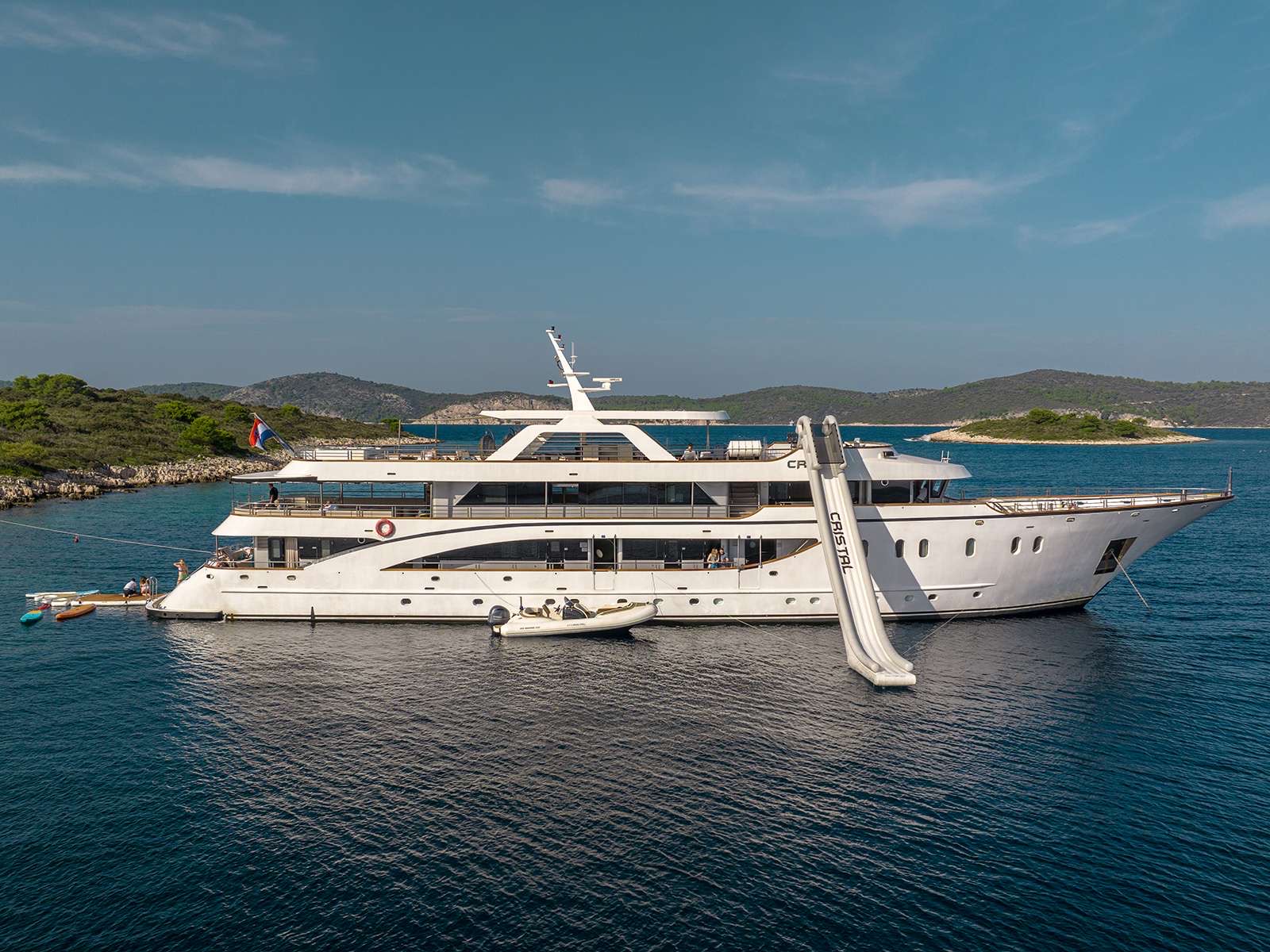
There is no single cheapest country: prices depend on the yacht more than the place. On three published listings, a July week for eight guests comes to about €67,200 on a 19 m catamaran in Greece, €95,200 on a 26 m motor yacht from Split and €52,920 on a 35 m gulet from Bodrum, with APA and a 10% tip but before VAT, which depends on the yacht and itinerary.
At a glance
| What this page compares | Three published listings, one in each country, as examples of trip styles |
| What it does not do | Rank the countries on price: the three yachts differ in type and size |
| Illustrative July week, 8 guests, before VAT | Greece €67,200; Croatia €95,200; Turkey €52,920 (APA and a 10% tip included) |
| VAT | Depends on the yacht, the contract and the itinerary in each country; ask for it in writing |
| Summer wind | Meltemi in the Aegean; maestral in summer and occasional bora in Croatia |
| The one thing to check | The total with VAT, and whether the yacht can do the route you have in mind |
The three example yachts
A crewed charter is a yacht hired with her captain and crew, usually by the week. A gulet is a traditional wooden Turkish motor-sailer, usually 25–40 m, built for relaxed cruising with a large shaded deck.
| Greece | Croatia | Turkey | |
|---|---|---|---|
| Example yacht | D2, 19 m power catamaran, 8 guests | Hunky Dory of London, 26.3 m motor yacht, 8 guests, Split | Bedia Sultan, 35 m gulet, 10 guests, Bodrum |
| Published weekly rate | €33,000–€48,000 (2026 rates, Goolets) | €62,000–€68,000 (Boatbookings; the listing does not state the year) | €25,900–€37,800 (Boatbookings; the listing does not state the year) |
| APA | 30% (Goolets) | 25–35% (HELM) | 25–30% (listing) |
| Crew tip | 10–15% suggested (Goolets) | About 10% (HELM) | 10–20% suggested (listing) |
| Main start ports | Athens and island bases | Split, Dubrovnik, Zadar, Pula (HELM) | Bodrum, Göcek, Marmaris, Fethiye (listings) |
| Trip style in this example | A fast catamaran for island-hopping | A motor yacht for hops between islands and towns | A gulet for slow cruising and swimming stops |
These three different yachts illustrate trip styles and budgets, not like-for-like country prices. A second Turkish example, Brothers, a 30 m gulet based in Fethiye, lists €15,400–€22,400 a week (Boatbookings), which shows how widely rates vary within one country.
What APA, VAT and plus-expenses mean
- Plus expenses means the charter fee covers the yacht and crew, and the running costs of your week are paid on top.
- APA (Advance Provisioning Allowance) is an advance the captain spends on fuel, food, drink and port costs and accounts for with receipts. See how APA works.
- VAT on the charter fee depends on the country, the yacht, the contract and the itinerary. HELM quotes 13% for Croatian charters; PwC's tax summary lists 13% as Croatia's reduced rate for accommodation on nautical tourism vessels. For Greece and Turkey, ask for the rate and its basis in writing.
Illustration: the same July week on each example yacht
| Line | Greece (D2, 19 m) | Croatia (Hunky Dory, 26.3 m) | Turkey (Bedia Sultan, 35 m) |
|---|---|---|---|
| Charter fee | €48,000 | €68,000 | €37,800 |
| APA at 30% | €14,400 | €20,400 | €11,340 |
| Tip at 10% | €4,800 | €6,800 | €3,780 |
| Illustrative budget before VAT | €67,200 | €95,200 | €52,920 |
| Per guest (8) | €8,400 | €11,900 | €6,615 |
The APA is reconciled against receipts, so the amount actually spent may differ. The gaps between the columns come mostly from the yachts, not the countries: a different yacht in each country would give a different order.
Summer wind in each country
- Greece: the meltemi, a dry northerly, blows mainly in July and August in the Aegean, strongest in the Cyclades. It tends to build during the day and ease in the evening, and spells last a few days (Aegean Islands; Dream Yacht Charter). The Ionian side is outside it.
- Croatia: the maestral, a northwesterly of about 10–18 knots on summer afternoons, and the bora, a gusty northeasterly that HELM says can exceed 40 knots, mainly early and late in the season in the north.
- Turkey: our sources do not cover the summer wind on this coast. Ask the broker and the captain about your route.
If anyone in your group is prone to seasickness, ask the captain how the route will be planned around the forecast, wherever you go. Our Greece season page has more on the meltemi.
Combining Greece and Turkey in one week
Some yachts offer it. Crossing the border means customs and permissions on both sides, which depend on the yacht's flag and how she is licensed. Ask the broker whether a particular yacht is allowed to do the route before you plan around it.
What to ask your broker
- What VAT applies to this yacht and route, on what basis, and is it in the quote?
- What is the yacht's flag, and does it affect where she can be chartered?
- Is the APA percentage fixed, and does a gulet quote include fuel?
- Are any cruising permits, transit logs or delivery fees charged separately?
- How much of the week is spent under way on the route you suggest?
- Which island group or coast suits our dates and the summer wind?
When this is not the right choice
- You want a like-for-like price comparison. This page compares three different yachts. Ask a broker to quote similar yachts in each country for the same week.
- You want empty anchorages in August. The best-known islands and bays in all three countries are busy in peak season.
- You want long passages every day on a gulet. Gulets suit relaxed cruising; ask how far a given yacht travels in a typical day.
Full costs are on our Greece and Croatia pages.
Questions people ask
Is Turkey cheaper than Greece for a crewed charter?
Not necessarily. Our Turkish example, a 35 m gulet, comes to less than our Greek example, a 19 m catamaran, but they are different kinds of yacht, and rates vary widely within each country. Ask a broker to quote similar yachts for the same week, with VAT.
What VAT is charged on a charter in Greece, Croatia and Turkey?
It depends on the yacht, the contract and the itinerary. HELM quotes 13% for Croatian charters, and PwC lists 13% as Croatia's reduced rate for accommodation on nautical tourism vessels. For Greece and Turkey, ask the broker for the rate and its basis in writing.
Which country suits families with young children?
Any of the three can, with the right route. Look for short passages between sheltered anchorages, and ask the captain how the plan will change on a windy day.
What is a gulet?
A gulet is a traditional wooden motor-sailer built in Turkey, usually 25–40 m with four to eight cabins and a large shaded deck. Gulet weeks are usually relaxed, with plenty of swimming stops; ask how much of the week is spent under way.
When is the best month for each country?
June and September suit all three: warm sea, fewer crowds than the peak and, in Greece, a weaker meltemi than in July and August. HELM rates June as the best month in Croatia.
Sources
- Goolets, D2 (Fountaine Pajot Power 67) Greece listing: 2026 rates, APA, gratuity, read 29 Oct 2026
- HELM, Create your Croatia charter (VAT, APA, tips, rates, winds, ports), read 29 Oct 2026
- Boatbookings: Hunky Dory of London (Sunseeker 86), Split, read 29 Oct 2026
- Boatbookings: Bedia Sultan (35 m gulet), Bodrum, read 29 Oct 2026
- Boatbookings: Brothers (30 m gulet), Fethiye, read 29 Oct 2026
- Aegean Islands (aegeanislands.gr), Climate: the meltemi, read 29 Oct 2026
- Dream Yacht Charter, Mastering the meltemi in Greece, read 29 Oct 2026
- PwC Worldwide Tax Summaries, Croatia: other taxes (VAT rates, reviewed July 2024), read 29 Oct 2026
Spotted something out of date? Send a correction. We fix it and note the date.