
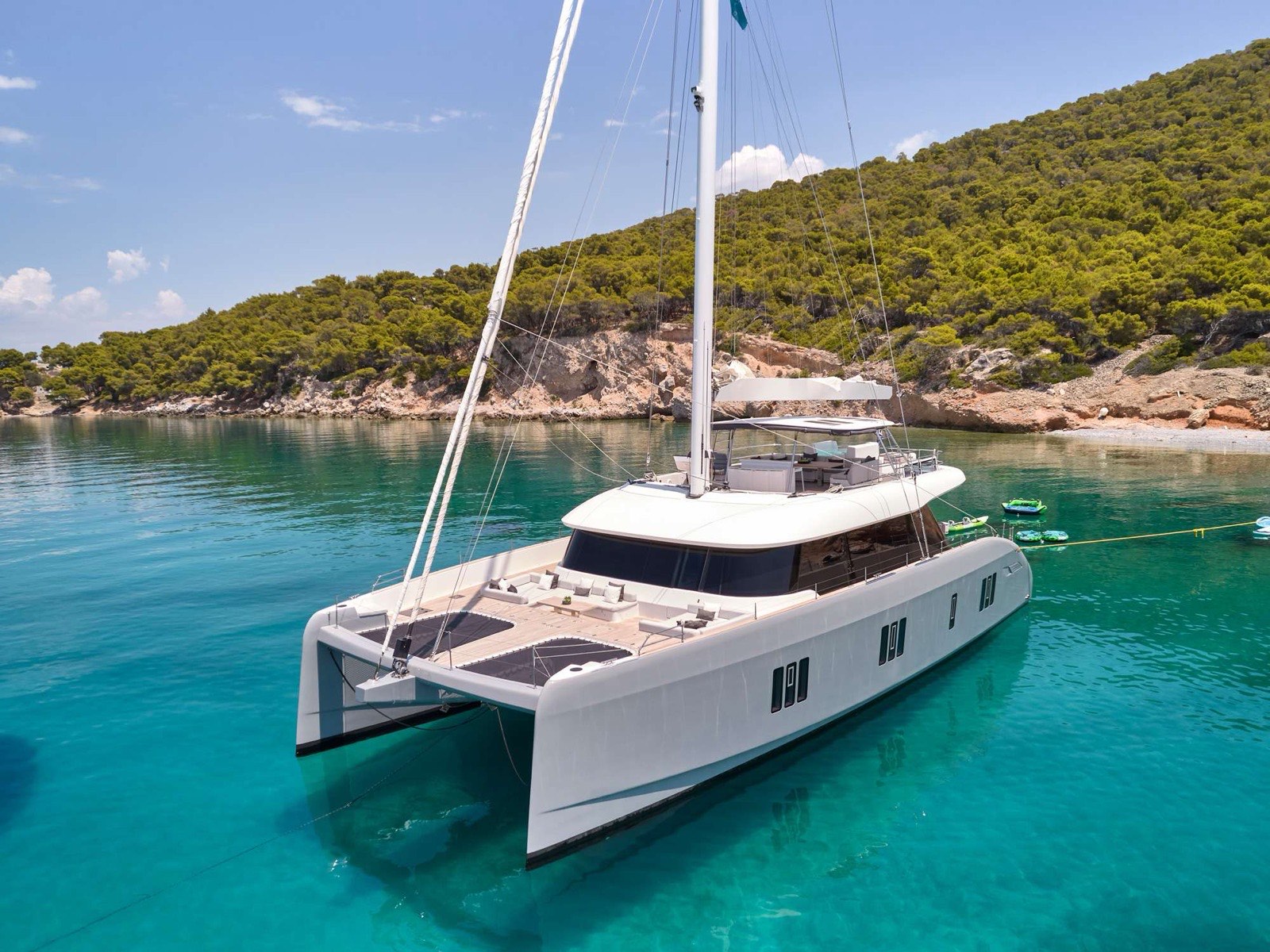
For most groups, June and September are the best months for a crewed charter in Greece: the sea is warm, the islands are open, and rates are below the late July to August peak. July and August bring the strongest meltemi wind, mainly in the Aegean. April, May and October cost least, with cooler water in spring and shorter days in October.
At a glance
| Best months for most groups | June and September: warm sea, islands open, below the July and August peak |
| Lowest prices | April, May and October, with cooler water in spring and shorter days in October |
| Peak season | Late July to August: highest rates, most crowds, strongest meltemi wind in the Aegean |
| The wind to plan around | The meltemi, a dry northerly that blows mainly June to September, strongest in July and August |
| The one thing to check | How the captain plans the route around the forecast, and what the fallback is |
How the months compare
The meltemi is the dry northerly summer wind of the Aegean. The shoulder season is the months either side of the peak: May, June, September and October.
| Month | Air high, Naxos | Air high, Corfu | Sea surface, Greek waters | Meltemi | Price vs peak, two listings | Crowds |
|---|---|---|---|---|---|---|
| April | 18.7 C | 19.1 C | 10–17 C | Rare | 46–69% | Very quiet; some tavernas still shut |
| May | 22.1 C | 24.0 C | 15–20 C | Occasional, from mid-May | 46–72% | Quiet; Orthodox Easter is 2 May 2027 |
| June | 25.9 C | 28.2 C | 20–22 C | Building | 72–84% | Busy from mid-June |
| July | 27.1 C | 31.2 C | 22–25 C | Strongest months | 84–100% | Busiest |
| August | 27.0 C | 31.5 C | 23–27 C | Strongest months | 100% | Busiest; Greek holiday mid-August |
| September | 25.1 C | 27.5 C | 21–26 C | Easing through the month | 59–84% | Busy early, quieter late |
| October | 21.9 C | 23.2 C | 19–24 C | Occasional | 56–69% | Quiet |
Air highs are long-term mean daily maximums from the Hellenic National Meteorological Service (HNMS) for Naxos town and Corfu, as tabulated by Wikipedia. Sea temperatures are offshore surface averages from Sailing Issues' monthly charts, from the cooler northern Aegean to the warmer south; shallow bays can be warmer.
The meltemi in plain terms
The Beaufort scale grades wind from Force 0 (calm) to 12: Force 5 is 17–21 knots, Force 6 is 22–27 and Force 7 is 28–33 (Met Office).
- Season: mainly June to September, with July and August the strongest months (Sailing Issues).
- Strength: often Force 4–5 as it sets in, and frequently Force 5–7 during the day in July and August (Sailing Issues).
- Time of day: it usually builds from late morning, peaks in the afternoon and eases around sunset, though it sometimes blows through the night (Sailing Issues).
- Spells: usually three to six days, sometimes longer (Sailing Issues).
How often it blows varies a great deal from one summer to the next and from one place to another. Historical counts are not a forecast for your week (Misios and others, 2022). Your captain will plan each day from the current marine forecast.
Which areas are more and less exposed in July and August
| Area | Exposure to the meltemi | Why |
|---|---|---|
| Cyclades (Mykonos, Paros, Naxos, Tinos, Kea) | Generally the most exposed | The wind runs across the central Aegean, and channels between islands funnel it |
| Dodecanese (Kos, Kalymnos, Patmos) | Exposed on open crossings | Harbours in the lee of islands are calmer than the passages between them |
| Saronic Gulf (Aegina, Poros, Hydra) | Generally more sheltered | Short hops close to Athens (Boatbookings) |
| Ionian (Corfu, Paxos, Lefkada, Kefalonia) | Outside the meltemi | It gets a gentler afternoon northwesterly, the maistro, instead (Sailing Issues) |
Sailing Issues names channels where the wind funnels, among them the strait between Andros and Evia, Paros to Naxos, and the passages around Ikaria and Fournoi. A sheltered anchorage is not a guarantee of a comfortable night: swell and gusts depend on the day's wind.
Which month for which trip
- The Cyclades in more settled weather: June or September.
- Families tied to school holidays: July or August, with the Ionian or the Saronic Gulf as options to discuss with the captain.
- Lowest price: April, May or October, accepting cooler water in spring and shorter days in October.
- Greek Easter: Orthodox Easter is 2 May 2027. Harbours and churches are busy that weekend, and the sea is still cool.
Before budgeting, see what a crewed charter in Greece costs and what APA is.
What to ask your broker
- Which season band does my week fall in, and how much would the week before or after cost?
- How does the captain plan around the meltemi, and what is the fallback route for a windy spell?
- Where is the yacht based, and is there a charge to start elsewhere?
- How does this yacht ride in a beam sea, and what do guests prone to seasickness usually do?
- Which island businesses are open in the first and last weeks of the season?
When this is not the right choice
- You want calm crossings in the Cyclades and can only travel in late July or August. Plan for windy days, or ask about the Ionian or the Saronic Gulf.
- Heat ashore is a concern. Corfu's mean August high is 31.5 C.
- You want warm water and every taverna open. Early April and late October are marginal.
Questions people ask
Is October too late for a yacht charter in Greece?
Not usually. Offshore sea temperatures average about 19 to 24 C, Naxos's mean October high is 21.9 C, and on the two listings we read October cost 56% to 69% of the peak week. Days are shorter and some island businesses close towards the end of the month.
Is Greek Easter a good time for a charter?
Orthodox Easter falls on 2 May 2027. It is a lively time ashore, but harbours are busy that weekend and the sea is still cool, at about 15 to 20 C offshore. It suits groups who value the festival more than swimming.
Which month is cheapest?
Usually April, May and October. On the two listings we read, those months cost 46% to 72% of the July and August rate. Each yacht sets its own season dates, so ask for the exact bands.
Is the sea warm in May?
Cool but swimmable for many people: offshore averages run from about 15 C in the north to 20 C in the south. By mid-June most Greek waters are above 20 C.
Which islands are less exposed to the wind in August?
The Ionian islands are outside the meltemi and get a gentler afternoon breeze instead, and the Saronic Gulf near Athens is generally more sheltered. Conditions still change day to day, so the captain plans each passage from the forecast.
Sources
- Hellenic National Meteorological Service, Naxos town mean daily maximum temperatures, as tabulated in Wikipedia's Naxos climate table, read 29 Oct 2026
- Hellenic National Meteorological Service, Corfu mean daily maximum temperatures 1955-2010, as tabulated in Wikipedia's Corfu climate table, read 29 Oct 2026
- Sailing Issues, Greek sea water temperatures by month (offshore ship data 1850-2006), read 29 Oct 2026
- Sailing Issues, Meltemi winds explained (season, strength, spells, funnelling channels, Ionian maistro), read 29 Oct 2026
- Misios and others, Decline in Etesian winds after large volcanic eruptions in the last millennium, Weather and Climate Dynamics 3 (2022): year-to-year variability of Etesian days, read 29 Oct 2026
- Met Office, The Beaufort wind force scale, read 29 Oct 2026
- Goolets, D2 power catamaran listing (2026 rates, by month), read 29 Oct 2026
- BeBlue Sailing, Lagoon Corali 2027 seasonal rates (price share by month, season end 6 November), read 29 Oct 2026
- Sailing Issues, When to sail Greece (season, Easter dates), read 29 Oct 2026
- Boatbookings, Greece yacht charter FAQs (Saronic shelter), read 29 Oct 2026
Spotted something out of date? Send a correction. We fix it and note the date.